February 15, 2014

The Aloe Harvest


Etta processing some of the aloe leaves
Long about September of 2012, Etta and I were given an Aloe vera plant by one of Etta's friends. Aloe is a succulent, which means it has thick, fleshy parts (leaves, in aloe's case) full of water. They tend to come from arid places and need less water that other plants, but there are many examples of succulent plants that evolved in temperate areas of the world, including some sedums. Many succulents reproduce asexually by growing clones of themselves (called "pups" by aloe growers) off of some portion of the stem. Each pup will eventually produce its own roots, remain there after the 'mother' part of the plant dies, and produce its own pups when it gets big enough.


We used it as a Christmas Tree that first year
We're pretty sure the plant we received was an offshoot of an offshoot of a plant Etta's friend Will received when he started college in 2001 or so, and it was a monster. We had to stake it to keep it from leaning over and snapping, and it grew much more quickly than any other potted plant I've ever had.

The open end of the leaf where it was attached to the plant

A couple of weeks ago, I walked into the bedroom to tend the potted plants in the window, and I was surprised to find two pups coming up off of our aloe! Until then, we weren't sure how we'd keep it alive when we harvested the leaves, but we knew we'd have to cut it down soon because of how tall and heavy it was getting. Thankfully, the pups came up just in time, so today we harvested and processed the leaves, and prepared the pups for transplanting.

A cross section of the leaf, showing gel and veins
To get the gooey insides out of each leaf, you basically have to cut off the green parts without taking too much of the gel inside. The green parts of the leaf contain the photosynthesizing cells, a little waste storage, and the waxy cuticle protecting the leaf from direct contact with the environment. Between the outside layers are loads and loads of cortex cells which have relatively huge areas to store water as well as sugars, minerals (vitamins), amino acids, and other chemicals (including salicylic acid, lignins, and saponins). A lot of these chemicals are great for our skin and for our bodies when eaten, which is why aloe has been cultivated for thousands of years. There are also veins (called vascular bundles in botany) running the length of each leaf used to carry water and nutrients up from the roots, and sugars out of the leaf to the rest of the plant.

The author holding a piece of gel.
We started processing each leaf by slicing off the sharp edges. Then, pressing the leaf flat, you can run a sharp knife under the skin of about a third of the convex part of the leaf. Once the first cut is made, it's easy to cut the rest of the skin off the rounded side, leaving the gel attached to the bottom. If you press the leaf very flat, you can then slip the knife under the gel and get most of it off. Inevitably, you cut through some of the cortical cells that store the water and chemicals, so the whole table gets covered in a mucus-y goo. However, it's held together as one unit by the veins and the bonds between the remaining cells. We're going to make the gel into several products for ourselves - skin ointments, conditioners, maybe even slip a little into some food (although it didn't smell terribly appetizing). We're not quite ready to use the gel yet, so we sliced it into chunks and placed it on a cookie tray in the freezer. Once it froze, we broke the chunks apart and stored them in a plastic bag in the freezer, ready to use when we need them.
 
 So what did we do with the pups, and how are we going to keep growing them? Well to start with, I cut the whole big aloe plant off at the soil line. Then, I peeled each leaf off the stem until there were about four left. I read that you can keep the few uppermost leaves and get them to root and keep growing as well. Unfortunately, they snapped off the stem a little too high, so I'm not sure they'll survive, but I'm going to try anyway.

The two pups along with the top of the mother plant, left out to form callouses before transplanting.
Once I was done with that, I carefully wiggled the remaining stem, the roots, and the attached pups out of the soil. The pups were attached to the bottom of the mother's stem by small, underground stems of their own. One of them already has one root coming off of it, while the other does not. To get them to root, first you have to leave them exposed to the air in a dark place for a day or two. In that time, they'll secret some of the chemicals stored in the leaves to form a callous over the wound. Once the callous has formed, you can transplant them without fear that they'll rot. Generally, you don't want to water transplanted succulents until a root system as formed to discourage rot, but you should mist their soil with a little water to encourage them to send roots out. Once they have roots, you can water as normal, which for aloe, is not very often.

We've really enjoyed having this plant; it's very easy to care for and it provides a wonderful material for our health, so we'll be careful to raise the pups to maturity. I'd strongly encourage anyone reading this to get one for their desk or a window sill at home. Check back soon for my upcoming post about jade (another succulent) and the other plants I've got growing in my window!

The Regular Farmer

February 14, 2014

Spit!

Have you ever been working in a garden, strolling through the woods, or looking at plants in a greenhouse when you noticed what looked like a wad of spit on a leaf or in the crotch of a plant? Perhaps, in a lapse of judgment, you touched the spit and noticed it was both oily and slippery, and kind of sticky at the same time. If you were so brave, and you kept a very sharp eye, you may have seen one of these guys jump or crawl out of the stuff you left on the plant:


Aptly called the "spittlebug", as well as the "froghopper", this insect belongs to the same order as cicadas and aphids. The cute green ones like our friend up there are the nymph of the species, meaning they haven't yet reached sexual maturity, and have to molt one more time before they're adults. You'll only ever find the nymphs in foam - the adults don't usually make foam, although they have the same diet as their younger brethren. They are more often the ones called froghoppers, because they look like really tiny frogs, and because they can jump huge distances. The first time I saw one, it was on a strawberry leaf until I went to catch it and it leapt off. I started hootin' and hollerin' to the rest of the crew because I thought I had found a tiny frog and I wanted to show them!


So you're probably wondering what the foam actually is. Not if you're smart, you're not! Skipping the rest of this post would behoove those readers with weak constitutions. Insects don't have salivary glands, so it's obviously not actually spittle. To figure this 'mist'-ery out, we need to look at what the spittlebug nymph eats. They survive by drinking plant sap and eating the xylem, one of the two types of tissues that transports nutrients through plants. Specifically, it transports water and nutrients from the roots to the leaves (the other type, phloem, carries sugars from the leaf, where they are produced, to the rest of the plant).

Most of their nutrients come from the xylem itself, but they drink a great deal of the sap as well. There are conflicting theories about how they form the spittle. One says they mix the sap with air in little organs inside their bodies, while the other says they do a little dance to create the foam as it runs down their legs. Either way, it passes through their systems and out of their anuses on its way to becoming foam.


Okay, that was a little gross. I apologize, but I wanted to get it out there before I go any further. Also, now you know one of the many reasons to wash your local food - even berries - before you eat it. We clean most of our crops a little, but I can't guarantee that strawberry you're eating never had an insect's excretions on it. As much as we may squirm at that idea, the foam performs a number of functions for the spittlebug. It keeps them moist and cool on hot, sunny days, and protects them from predators. Even if a bird or larger insect knows to look inside the collections of spit to find these guys, the stuff is really slippery, as I said before. I've accidentally brushed the spit a few times, and the spittlebug inside was always left there, looking around before it hopped away to find a new place to feed.

The foam also serves a useful purpose for us humans! I can't back this up with any website or evidence, just an anecdote. I was picking strawberries one day when I brushed my hand against a nettle, or something similar. After finding the plant and ripping it out with my multi-tool, I was left with an itchy red patch on my finger. Normally, I can put up with the discomforts of my job, but this one was really bugging me. I couldn't cure it by swimming in a cold pool like I did when I got stung at age ten, so I thought, "What would Bear Grylls do?" Realizing he would probably find something in his immediate vicinity and use it to treat the nettle sting, I looked at what I had with me. After preliminarily eliminating strawberry juice as a treatment, I went looking for a little pocket of spit, and found one handily. Two topical applications, spaced about 15 minutes apart cleared it right up! So if you're out in the woods and you run into a patch of nettles, look to the pine trees, the spittlebug's favorite food, for help.

These insects are still pests, cute or not. Feeding on the xylem hinders the plant's ability to transport water from the root to the stalk and the leaves. One individual won't do much damage by itself, but a swarm of these guys can lower a crop's yield. Don't panic if you find them, though! Panicking leads to nasty things like insecticide, and that's never good for your plants. I'm happy to report that all you need to get rid of these expectorating nuisances is a hose or even a watering can, which will do your plants some good anyway.

Squishily,
The Regular Farmer

January 4, 2013

The Great Cannellini Experiment of 2013

I'm finally done with my experiments, and now we can talk about seeds. We don't interact with seeds much, except when we eat them, but I think people rarely ponder what a seed really is while they're chewing them to bits. Corn, beans, oats, wheat, coconuts, and even the peanuts I'm eating right now are seeds. They come in all shapes and sizes, but they all allow plants pass their genes on to a new generation, sometimes across vast stretches of time and space. They can survive much more extreme weather than their parent plants, and they pack enough nutrition to grow a baby plant's stalk and roots until it can start making its own food. How do they do this? Take a look at a dissected cannellini bean:

Well Howdy-do!

You may have just exclaimed, "Hey! That's a whole friggin' plant right there!" in which case you should apologize to anyone around you who was trying to work or study. Good? Good. You're right though, that is a plant, or rather, a plant embryo inside the bean. That's the whole point of seeds, to protect an already-developed embryo while it waits for environmental conditions that will allow it to grow successfully. Every slice of 12-seed bread you eat is covered in little baby plants.

That bean is in the process of germination, which occurs when that little plant goes through to break out of the seed and start growing. Seeds germinate when they have the right amount moisture and oxygen around them. Sometimes, they require other environmental qualities, like exposure to red light (which only reaches the ground when the tree leaf canopy is gone) or a long period of cold followed by warming soil (which would happen to a seed that fell in the fall). Basically, when the environment is right for the plant in the seed, it sets off a chain reaction that gives the embryo access to the energy stored in the seed so it can start to grow. Beans are pretty easy to please, and will germinate in a wet paper towel left in a dark, warm spot for a few days.


These beans have all germinated, as you can see by the roots sticking out of the seed casings. The roots are the first to grow, and reach down deep into the soil to secure a source of water for the embryo before the stalk starts to grow. These seeds were all oriented differently in the paper towel, so their roots are growing in different directions. If I had been able to take a picture of them without moving them first, all the roots would be pointing downward. Gravity affects hormones in the embryo which cause the root to grow downward and the shoot to grow upward.

We all know that plants make their own food to power their growth from sunlight, so how do the embryos grow if they're buried in the soil? The cotyledon (caht-uh-lee-dun) is packed full of food energy, which the plant stored in the seed before it fell off. A lot of plant seeds - like those of beans, tomatoes, squash, cherry, apple, and walnuts - have two cotyledons. In a bean, the cotyledons are the fleshy part of the seed - everything besides the embryo. Other plants have just one cotyledon, although some of those have an extra source of food inside as well, called the endosperm. Common monocots (plants with seeds with one cotyledon) include corn, all grasses, coconut, bamboo, date palms, sugarcane, and pineapple. Monocots usually have different qualities than dicots (two cotyledons). For example, they tend to be much more flexible, and stand up to wind better than dicots of the same size. 


After examining the beans after a few days in the paper towel, I sowed the ones that had germinated in a pot and left them on the window sill to grow. This photo shows the next stage in their development: emergence of the stalk from the soil. The stalk starts to grow toward the surface using energy from the cotyledons. They grow curved like that at first to protect the apical meristem (the point of growth at the tip of the stalk) from injury in the soil. As soon as sunlight hits the stalk, it starts to photosynthesize food to supplement that in the cotyledons, hence these stalks have turned green with chlorophyll. On each of these plants you can see a stalk and one or two distinct cotyledons, halves of the bean I planted days before. These will remain attached to the plant until their food energy is gone. You can also see the seed coats, thrown off almost like egg shells next to each plant. Fun Fact: At this point, the stalks were less than an inch tall, but the roots were starting to grown out the bottom of the 4-inch pot already!


Once the cotyledons are fully aboveground, the stalk starts to straighten up and we can see the embryonic leaves come out. These leaves are considered part of the cotyledons, since they were present in the embryo. True leaves usually look much different, as you'll see, and only grow after the plant has germinated. Embryonic leaves are usually very large to collect as much sunlight as possible to fuel the growth of true leaves. 


Here are some pictures I took in the last few days to show the difference between embryonic leaves and true leaves. The plants are about 2 weeks old, that is, since they emerged from the soil. On the left, you can see the embryonic leaves have grown very large. If you look closely, it's clear that there are two embryonic leaves growing directly across from one another on each stem, each of these corresponds to a cotyledon.The leaves are very broad and spade shaped. On the right is the first true leaf to emerge from the stem. Bean leaves of this species have three leaflets on each leaf, so what you're seeing there is just one leaf. The apical meristem is within the small structure at the base of the leaf. The stalk will continue to grow from there, and send off another leaf higher up. This second true leaf won't be directly across from the first one, either, but something like 137 Degrees around the stem. The third one will be 137 degrees from the second and so on, and thus create a whorled pattern if viewed from above. This pattern lets the leaves absorb lots of sunlight without shading each other out.


And finally, here's what happens to the cotyledons as they get older. They still look like beans, don't they? I personally think it's amazing that they can become so green and soft after being dried out for so long. As their food energy gets used up, they shrivel because the starches are being broken down and transported to the roots for use. What's left of them is mostly structural cells, but they can still photosynthesize a little bit. In the next few days they'll shrivel more, the stem will form a sort of scab between them and itself, and they'll fall off and get consumed by bacteria in the soil, which will make even more of their nutrients available to the roots.

In addition to protecting plant embryos from harm, part of what makes seeds so valuable is their ability to lie dormant for long periods of time while waiting for the exact right conditions. This is why weeds are so difficult to get rid of, and why a forest that burns in a fire is so quick to recover. There are millions of seeds biding their time in any given plot of land, not germinating until they have the space and nutrients to survive. For weeds, this usually means that with every cultivation of a field, new seeds are circulated to the ideal soil depth and can then compete with the crop plants. An interesting idea to think about is how seed dormancy this affects the gene pool of a given species. Many plants can reproduce asexually - that is, clone themselves - if they are not pollinated before the season ends. This allows plants that fail to reproduce sexually in one time and place to try again potentially miles away and years down the line. More on that when I write about plant reproduction.


Of course, the longer a seed lies dormant, the less likely it will be to germinate successfully, although that varies from species to species. Some seeds can't last two years before they lose viability, others can survive hundreds to thousands of years in the right conditions. For example, I just read about a Judean Date Palm, which has been extinct as a species for since about 200 C.E., successfully germinating in 2005. The seed was apparently preserved in a very dry environment from about 45 B.C.E. until the 1960s, when it was discovered. This tree, Methuselah, was the only one to germinate out of all the specimens they found, but it flowered in 2008 and is therefore capable of reproduction. They plan to cross it with an Egyptian date palm species and harvest the first fruit around 2022. Crossing it with another species won't propagate it as a unique species, but it will reintroduce its genes into the date palm gene pool. The Judean Date Palm was widely used for medicinal purposes, which is probably why it went extinct. By letting Methuselah reproduce, we will be able to see what, if any, useful qualities this species has and hopefully create a hybrid species that can carry those qualities into the future.

I want to mention again before I sign off that it's only been 21 days since I started to germinate the cannellini beans. In that time, the embryos they contained have grown to hundreds of times their original size, and they're just getting started. The full bean plants will be 2 to 3 feet tall and have hundreds of leaves and hundreds of new seeds if they get pollinated. Take these banana seeds on the left here as another example. They'll grow into trees over ten feet tall! Whenever I spend time seeding crops, I marvel at the power of seeds to preserve their species. They contain all the genetic information needed to make a whole, new living organism, all inside a minuscule, near-indestructible pod. Next time you have one in your hand, take a good, hard look at it, and see if you can fathom that. You might be surprised at what you learn.

Thanks for Reading,
The Regular Farmer


-All photos except those of Methuselah the Judean Date Palm and the Measured Banana Seeds are by Ryan Heisler and may be used and distributed under the Creative Commons Attribution-Share Alike 3.0 Unported license.
Creative Commons License
-Photo Methuselah the Judean Date Palm: Author: Benjitheijneb at Wikimedia Commons. Creative Commons Attribution-Share Alike 3.0 Unported License
-Photo Measured Banana Seeds: Author: Firetwister at Wikimedia Commons. Creative Commons Attribution-Share Alike 3.0 Unported License

December 28, 2012

Animal Sacrifice


Hit Play!

What you're hearing right now is from a recent episode of This American Life. Now, I've had a love-hate relationship with this show for a long time. From the quality of the show, it's clear that they work hard on their stories. It's too bad most of them are either depressing or really creepy to listen to (alone in the house at night, at least). It seems the only good bits are in the old shows, or stolen from The Moth Radio Hour, because those people know how to tell stories.

You should listen to it. Did you? Good. If you didn't here's the long and short of it: An animal rights group stole a bunch of rabbits from a rabbit farm to save them from their slaughter for meat. The babies of those rabbits froze to death as a result of their parents' absence. The rights group donated the rabbits to a rabbit shelter, who had given them to new owners, and played legal keep away with them when the farm asked for them back.

Eventually, all of them were returned to the farmers, but not without lots of bad press and hate mail for every party involved. Camas Davis, the narrator and owner of an organization that teaches people to slaughter whole animals got it, the farmers who raised the rabbits got it, and the animal rights people got it. All of them believed they were acting humanely, but their actions engendered bile and hatred from the other side of the debate. What went wrong?

First, I would submit that hate mail and death threats are never justified in our society. I know it feels good. Self righteous anger is an addicting emotion because it releases a ton of dopamine into our brains. That shit is for monkeys, though, people. Seriously, the reason our brains make us feel so good to get mad at 'the other' is because that helped our ancestors survive in the jungle and the steppes. They raided our caravan? They invaded our encampment? Those apes stole fruit that we apes were gonna eat? Kill them!

And they did kill them. So much so that that attitude itself became a survival strategy. Everyone who was disinclined to it was killed off. In my opinion, it is one of the evolutionary shackles our past has wrapped around our ankles, and we need to cast it off if we ever hope to get beyond our present: moderate technological success that we can't sustain paid for by war.

We have to work hard to overcome it, because it is so hardwired into our chemistry. Telecommunications and the sheer size of Earth's population have allowed humans to give into that othering of people that feels so nice. Hop on the internet, pick up a phone, and suddenly we're anonymous, or at least hard enough to track down, and among so many people who don't know us that there's no societal consequence for our actions that affects us directly. So we keep doing it, because it feels good. Maybe we feel shame at it, hem and haw over the things we said, but eventually we shrug it off. They're the bad guys, anyway, we didn't do any real harm.

In most cases, like this one, no one's the "bad guy." The butcher and the farmers were trying to make a living, and treated the rabbits with respect from birth to death. The animal rights people wanted to save the rabbits' lives. The animal rights people demonstrated the possible consequences of demonizing the other side. It allowed them to steal the rabbits - that is, part of the farmers' livelihood - without remorse, and caused the painful death of other rabbits, something I'm sure they didn't intend. They attracted their fair share of negative attention for that, but that didn't stop the hate mail coming to the farmers.

Who were the people writing awful things to Camas or the rabbit farmers? You might think, "Oh they must have been crazy vegans or something," but then all you're doing is demonizing the other. Surely some of the writers do not eat meat, but I'm willing to bet that most of them do, or have by choice for a significant portion of their lives.

Which brings me to my point: Americans have totally lost touch with the sources of their food, especially their meat. The animal rights people probably don't eat meat, but I know from experience that the idea raising and slaughtering bunnies would make most people uncomfortable, even the guy down at Pizza Town getting a meat lovers'. Hell, I don't like to think about killing rabbits, but most people I meet, who I can reasonably assume are meat eaters, flinch when I tell them that I've killed a chicken before. I shudder to think what their reaction would be to how one goes about killing a cow.

It's a messy, smelly, morally difficult task to kill an animal for food. I like that Camas mentions how difficult it is to slaughter animals, which she does professionally to teach people how to do it. She says it never gets easier, and I believe it. When I slaughtered that chicken, I had a somber, spiritual sense, and I'm sure it will be there when I do it again. I think that sense is necessary, though. Why should we get to eat animals without thinking of their sacrifice? Shouldn't we understand the consequences of our diets, and be prepared to accept them or give up meat?

I think ignoring animal sacrifice for our food is what caused so much outrage at this case and at others around the country (like that of two working oxen at Green Mountain College in Vermont). Americans want to eat meat in blissful ignorance. When the media reminds us of the violent deaths that animals undergo for that lifestyle, it reminds us of the inner conflict we feel over eating another conscious organism.

It's time for us to stop ignoring the animals we eat. My good friend, and the first person who ever took time to teach me about farming, Douglas Jowett, once told me about the agreement that humans make with farm animals. We, as farmers, agree to take care of our beasts - to protect them from predators, pathogens, and bad weather - in exchange for the goods they can offer us, like meat, milk, and fiber. Perhaps that's why my old employer can slaughter 120 chickens before lunch without batting any eye, but the time a coyote got to one of the old hens, Princess, she broke down crying. Princess had done her duty on the farm, and was no good as a meat bird, but that agreement still weighed on the farmer. She couldn't euthanize her or abandon her to nature, so she kept her around, let her enjoy her life, and kept her fenced in at night. When something ate her, maybe that felt like she let Princess down.

I think that agreement runs deeper, between humankind and our livestock breeds going back thousands of years. Look at domestication from their point of view. The animals who were not very aggressive were the ones who would not survive long in the wild, but they were also the ones who could live among humans without getting spooked and killing everyone. Their docility gave them a survival advantage with us, because we had a use for their bodies, and thus had a stake in passing on their genes to a new generation. So we collaborated. We made sure they had babies, they gave us food, clothing, and transportation.

In passing on their genes, we selected the ones we liked, the ones that gave lots of meat or particularly soft fur. The animal rights activists would have them 'return to nature,' but that misses the point on several levels. Most cows wouldn't survive in nature today. Some could, and no doubt a few strains would regain their lost aggressiveness  but letting them all go would just risk losing their genes forever, and would represent a failing on our end of the bargain. That notion also ignores the fact that we are nature. We're just particularly successful apes that figured out how to get other animals to make us things we couldn't make ourselves. We're not the only species to do that, by far. Ants farm aphids the same way so they can drink the nectar they extract from plants. Ants are definitively part of nature, why aren't we?

I think what I'm trying to say is that we're on a team with all the cows, goats, chickens, sheep, rabbits, bees, ducks, and turkeys whose resources we use. We have to value them as partners in our collective fight for survival. We must also be careful not to subjugate them, true. Factory farms and the modern American diet are a huge failure on our end to uphold the agreement. It is not worth destroying our world with CO2 and slaughtering masses of animals with no dignity so we can have chicken every night.

What is worthwhile is thinking on our relationship to meat. Cut down for your own health, our planet's health, and to stop demand for factory farmed meat. But don't swing too far the other way. We have been struggling alongside animals as long as our bones can remember. Let's reestablish a healthy partnership with them, one based on respect and mutual benefit.

Moo,
The Regular Farmer

December 13, 2012

Botany for Gardeners: Cells are Miracles that live Everywhere

I just finished reading my introduction to Botany, written by Brian Capon which I hope has prepared me to work through this behemoth of a textbook in the long, cold dark ahead. It's a fairly well-written book, and concisely describes the basic parts of a plant's anatomy their functions. After reading Michael Pollan's visceral, no-bullshit take on plants, which really gets you feeling and thinking like a plant might, this botany book tastes a bit sterile. The author also vacillates between glossing over subjects because the reader is not knowledgable enough and neglecting to mention important basics. Neither of these problems really detract from my overall opinion, however.

If there's one message I took away from this book, it's that plants are inconceivably complex, sublimely beautiful, and capable of feats of chemical engineering that humans will never match. They make and store their own food from sunlight, air, and water. Think about that for a second: with those ingredients, the average human would end up with sweat, urine, and a sunburn. Plants use that food along with minerals in the soil to reach deep underground, fan out over the earth, and reproduce. Reproduction isn't as easy as it is for us, either. Most plants either fill the air with enough pollen to choke a horse and hope it lands in the right place, or they produce delicate, colorful, fragrant structures that trick totally unrelated species into hand delivering the pollen where it needs to go. All with chemicals of their own making.


Sorry to bother you, ma'am. I'm here to clean out your
stamens and give your stigmas a once over.

If you have even the slightest interest in plants, you should read this book. It's a pretty easy read, and you'll start to appreciate grass, trees, and even your food in a whole new light. Before you go, though, I want to share two of the most striking subjects the book taught me about: seeds and stems.


Stems support the weight of the plant and its leaves, but might only be a few hundred cells across. The cells vary in type and size throughout the stem, each acting in concert with those around it to execute the functions of the plant. Let's look at the Lamium orvala (AKA Deadnettle) at right. The thin, light green stalk from which the leaves and flowers are growing, is the stem (I know, this is tough stuff to grasp). That stem has a relatively tough layer of cells around the outside to keep water and nutrients in and pathogens out. Within that there are bundles of cells that transport water up from the roots to the leaves and flowers, some that transport food down to the roots, and others that primarily divide to make the stem thicker as the plant grows up. Here's a beautifully prepared cross section of a deadnettle stem:

Before you go out and buy a microscope, understand that this stem was professionally sliced and dyed to look like that so it's easier to identify different structures. Every one of those globs is a plant cell, but they're all fulfilling lots of functions. Here are some of the tissues of a plant stem, as seen in deadnettle:

  1. This row of small, tightly-packed cells is the epidermis, or skin, around the stalk. It prevents water loss to evaporation, and keeps out invaders like bateria and fungi that would infect the plant and destroy it.
  2. The red cells here are xylem cells, which carry water absorbed by the roots up into the leaves and flowers of the plant. They are long, tubular cells that retain their sidewalls, but lose the top and bottom caps, allowing water to flow more quickly than it would through the cell walls. These vein-like structures are what spittlebugs, aphids, and other true bugs tap into when they feed on a plant.
  3. The larger blue cells outside the xylem bundles are called phloem, and they carry the nutrients made by photosynthesis from the leaves to the roots, where they can be stored for use later. You can see the phloem forming a ring about 2 cells wide all the way around the stem. (remember PHloem = PHood)
  4. This brown-looking group of cells, called the cambium, continues all the way around the cell between the large teal cells (see E) and the blue phloem cells. Its cells divide frequently and occupy space in one of three directions. Cells that end up inward become xylem or parenchymal (see E) cells, those that go outward become phloem cells, and some move sideways to make sure the cambium remains intact as it and the stem increase in circumference. In this way, the stem only grows in girth from within. A separate organ, an apical meristem* grows from the top of the plant, laying down new layers of cells to lengthen the stalk. The cambium inside the stalk can also be called a lateral meristem, since it grows sideways.
  5. These big, blue beauties are called parenchymal cells, and they make up the bulk of plant tissues. They can store waste products, secrete healing resins, store fats and starches in roots, and perform lots of other functions depending on their location. A parenchyma you may have seen today is the pith in an orange.
  6. This large space is just that. This stalk is hollow, probably allowing it to sway more in the wind than other plants. Many other green plants' stalks have a cortex made of parenchymal cells.
  7. BONUS: I just learned about this kind of cell myself while reading about this microscope slide. The structures in the corners are made of collenchyma cells, which are a bit like xylem cells, in that they are long and tubular. They also grow thickened walls, creating fibrous masses running the length of the stalk. This gives the stalk a lot of structure and helps it stand up straight when it gets moved by wind or an animal. Plants kept in a completely windless place do not grow collenchymae as much as plants that get blown around. The fibers in a celery stalk are collenchymal structures.
And that's all in one species of one type of plant! Woody plants have all these structures too, but many of the cells "die" by building too many cell walls. They don't function as cells after that, but they provide much more structural support that living cells. There are also different types of cambia, xylem, phloem, and parenchymae, and some plants have other structures because of the way they grow. To learn about all of them, you'll have to read the book.

If you think all that's impressive, wait til you hear about seeds. They're indestructible escape pods that allow plants's genes to survive weather extremes and emerge when everything is safe for a new generation to grow. Seeds will be in an upcoming post, once I finish with some...experiments.

Mwahhahahahahahahahahahaaaaaaaaaaaaaaaaaaaaaaaa,
The Regular Farmer


*"apical" means 'at the apex or end', "meristem" comes from Greek meristos, meaning 'divisible', and German xylem, meaning 'wood.'

-Photo Bee and Flower: Author: John Sullivan Source: pdphoto.org. Public Domain.

-Photo Lamium Plant: Author: Kurt Stüber. Creative Commons Attribution-Share Alike 3.0 Unported License
-Photo Lamium Cells: Author: Micropix. Creative Commons Attribution-Share Alike 3.0 Unported License. I added the letters and arrows.

November 27, 2012

Plants Have Been Manipulating You All Day

I ordered five books for this winter a week or so ago, and the first to arrive was Michael Pollan's The Botany of Desire: A Plant's Eye View of the World. I bought it as lighter reading I could do between textbook stuff, and it proved to be just that in a very good way. I ate it up, and I'm going to try to make this as little like a book review as possible. You can find a copy here.
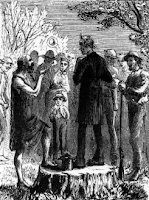
Johnny Appleseed
John Chapman, AKA Johnny Appleseed, left,
is a much wilder, more "Dionysian" character
than your 4th-grade teacher wanted you to know 
Pollan divides the book into four chapters, each exploring how one plant has used humans as tools to propagate itself in nature. He opens the book by presenting evolution backward (from the plants' point of view) to get the reader used to thinking about plants as subjects, not just objects of our will. He points out that instead of locomotion, plants have focused on evolving very complex chemical processes, aside from photosynthesis, that help move their genes around the earth. A very basic example, and the subject of chapter number one, is the apple. Like many fruiting plants, it has learned how to turn water, sunlight, and minerals into sugar, pack that sugar around its seeds, and then protect the seeds with bitter-tasting cyanide of its own making, all so that mammals like us will eat the fruit, but drop the seeds somewhere else, thus spreading its genes.

Semper Augustus
Semper Augustus - Unknown, pre-1640.
Tulips of this kind, caused by a rare viral
infection, sparked economic insanity in
17th century Holland
I would argue that Pollan uses the first three chapters to get the reader used to this idea that plants are subjective creatures, each with its own needs and desires, that manipulate the world around them to spread their genes. Then, in the fourth chapter, he tackles Monsanto and genetically modified foods, once the reader is ready to be critical, but thoughtful at the same time. The rest of the book is fascinating in its histories of Johnny Appleseed, the tulip craze of 17th century Holland, and the complicated relationship between humans and cannabis, and I would highly recommend it just for them. The chapter on potatoes, though, is the real meat of the book, and the one I think is important to discuss with you all, whether you read the book or not.

Potatoes have evolved to satisfy the human desire of control, in Pollan's opinion, and he demonstrates that with the history of potatoes in Europe. When the potato arrived there, it was highly unpopular—as a member of the poisonous solanacea family (along with the tomato), as a food of the 'conquered savage', and as a tuber, which most Europeans had never eaten before. However, the Irish poor welcomed it with open arms for its ability to grow vast quantities of food in the near-barren soil they had, its high nutritional value1, and its help in freeing them from the British Economy, which followed the price of bread and kept them poor. Alas, they experienced a 266% population boom depending on one potato variety (hilariously called "The Lumper"), which fell victim to Phytophthora infestans, a.k.a. Late Blight, which all but wiped out the crop. Pollan says, "one in every eight Irishmen—a million people—died of starvation in three years..."2 Many more went blind or suffered other illnesses from lack of nutrition. Pollan calls the Irish example, "...the biggest experiment in monoculture ever attempted and surely the most convincing proof of its folly."3 It is not mere chance, then, that he tells this story along with its modern analog, set in Idaho.

Potato field
A modern field of potatoes

You know how popular potatoes are. Why, you're probably eating one of McDonald's perfect, golden fries right now, you slob. Well, in order for McDonalds to get their fries so crispy and golden, every year they need millions of tons of one type of potato, the Russet Burbank this time, completely free from defects. Enter industrial potato farming. You'll want to check out the map in that link. If you zoom in, you'll see thousands of green circles, each a potato field 135 acres in size (or about 1/2 mile in diameter). At the center of each is a machine called a pivot (visible as lines here), a quarter-mile-long hose on a frame that stands high above the field and that stretches to the outside of the circle. The farmers use the pivot to spray water, fertilizer, and more poisons than you can imagine throughout the season.

A pivot irrigating a field of organic potatoes in Jordan.
Many of these fields are completely sterilized every season through the application of herbicides and pesticides. With no bacterial or insect life in it, the soil cannot produce any minerals for plants to use, so farmers must buy in all the nutrients necessary for their plants, as well as poisons to use throughout the growing season, many of them targeting the delightful fellow at left: the Colorado Potato Beetle. This pest lives virtually anywhere you 
can grow a potato, and just a few can strip a plant of leaves in a matter of days or hours (they're bright green inside when you squish them, by the way). Aside from them, worms and grubs love to burrow into potatoes under the soil, and diseases can wipe out whole fields. Woe are we, then, that we insist on demanding perfection in our vegetables; monoculture far worse than that of Ireland's potato experiment requires powerful toxins to sustain it.

Enter Monsanto, a genetic engineering company with a nasty reputation among organic farmers, in a move that, surprisingly, seems less evil than one might expect of them, in light of the plight of Idaho potato farmers. Back in the 90's, they engineered a potato variety they called New Leaf, by adding a gene from a bacterium commonly used to kill farm pests like the potato beetle, called Bacillus thuringiensus (BT). This gene allowed the plants to produce their own BT toxin in every cell, which would kill any pest that took even the slightest nibble. In Idaho, some farmers are lucky to see a $50 profit per acre of land in a good year, so eliminating a few sprays of the ol' beetle buster could potentially save them a lot of money, and reduce exposure to toxic chemicals for them and the American Consumer, so why did New Leaf fail to catch on?

Well, it seemed all but established in the food industry when McDonalds started buying New Leaf potatoes for its fries. When consumers found out, though, they got scared, understandably. GMOs still rile people up, so it's no surprise that back in the 90's, anti-New Leaf sentiments among McDonalds' customer base could climb high enough to prompt the company to stop buying them, sounding their death knell. If I were to make the choice between GMOs and poisons, I, like Pollan, would probably choose GMOs, but I'd rather not eat either. Pollan makes the point that we have no way to know how GM foods will affect our health, but we do know that shitloads of poison (I'm paraphrasing) are bad for us.

He also makes the point, however, that every genetically modified organism is different, and bound to affect us in different ways. A flounder gene in corn might do no harm, but a platypus gene in wheat might turn on the cancer switch. It's also hard to know if the genes we're not used to eating might cause a buildup of chemicals in us that intensifies and causes harm over generations. In the interest of bashing pesticides and GMOs equally, I'd like to share a story from Pollan's visit to Monsanto's lab, where he helped a scientist plant some baby New Leafs.

First, Pollan learned that there are two ways to modify the genes of a plant. The more science-y method involves inserting the desired genes into a bacterium with an enzyme, then soaking a slip from the desired plant in a culture of the bacteria before planting and growing it. This works best with broad-leafed plants, like the potato. More on that in a minute. The other method is a lot more awesome than that. It involves soaking steel balls in DNA, loading them in a 22mm cartridge, and shooting them at a leaf. If you're lucky, the DNA ends up in the right spot, and the plant expresses the genes in the qualities you were going for.

I'D REALLY LIKE WINGS AND A TAIL!
Anyway, back to the potato. So the process of developing a hearty variety of potato with bacteria genes is not as linear as the phrase "genetic engineering" would suggest. They plant thousands of slips impregnated with the new DNA at once and wait for the plants to come up. Because the gene-embedding is so inaccurate, almost every new plant is different. So what do the scientists do? Select the ones that display the right qualities and breed them! Just like farmers have been doing for thousands of years. They simply give nature a cheat code to unlocking a combination of genes that the species would have taken millennia to develop on its own, if ever.

As a final thought I'll leave you with this one Pollan left me with: The species of Earth have been developing over billions of years by exerting pressures on one another and reacting to those pressures. Plants developed complex chemical processes, like the synthesis and storage of sugars, because their end products enticed animals to spread their genes all over the planet. Even in the instances of 'artificial' selection, in which humans have encouraged plants to grow bigger or more robustly, the plants are only improving upon traits they already had in order to spread their genes more efficiently through humans. Genetic engineering is the first technology in the history of this planet that allows humans to exert their will entirely over other species. Humans don't select and encourage the best specimen, they select the trait and force it into the species solely for their benefit. The GM plant is no longer a subject with a will of its own, but truly the object humans have always thought of it as.

All told, The Botany of Desire is an excellent book that is worth much more than the three days it will take you to devour it. It is fascinating and informative, and entertaining to boot. Let me know if you want to borrow my copy.

Dreaming of Cider Orchards,
The Regular Farmer


1. It lacks only vitamin A, which milk provides, so mashed potatoes alone can keep a person healthy.
2. Pollan, Michael. Botany of Desire: A Plant's Eye View of the World. New York City: Random House Inc. 2001 p. 230
3. Ibid. p. 230-231

November 25, 2012

Educating Myself

Well, the collards and tomatoes of View South Farm have flourished and wilted out of existence in the tide of life and death that all nature undergoes every year, and in all these months I haven't found the time to write about it. Hopefully soon I will be able to share some photos and stories of my harrowing battle with cabbage moths and the delicious produce I got out of my verandagarten this year, but I have other things to discuss first.

I've been thinking lately that it's time I got serious. I'm long done with school, have decided that the stuffy life of Arabic study is not for me, and am well established in my own place. I cannot whine, like many of my cohort have done, that the economy and higher education has left me a jobless sap living at my parents house (even if Tom Ashbrook thinks I should!). Of course, I haven't found work in Islamic Studies, but I think if that was my passion, I would have had no trouble cultivating the relationships and applying to internships that I needed, not to mention it would have been easier to buckle down and learn more Arabic than my professors expected of me. No, my field lays outdoors, in the soil with the plants that will feed me, my family, and my neighbors til we all go the way of my collard greens. It just took me a while to admit that to myself, and I still feel bad that I didn't discover it earlier.*

 I've had enough of the fooling around, though, and am taking my first steps on the long road to sustaining myself as a farmer. I have the foresight now to think that this road itself is my destination. I just hope I can keep that perspective when I feel the pressure to veer off, plant myself, and decide that I can go no further.

Anyhow, my first step was to get back to working outside. As it turns out, there are quite a few farms outside of Boston, but I decided not to go to work for them, at least right away. Instead, I work for a certified organic landscaping company. I won't learn about crops in my time there, but I will learn about planting, feeding, and treating plants, pruning trees, and fostering healthy soil. I'm also working a lot harder and longer in a day than I ever did on a farm (and that will change), so feel that when I do get back to food production, I will be much more prepared to meet the demands on my body. Also, I earning more as a landscaper, which will allow me to save for when Etta and I go on our grand WWOOFing adventures, and for buying land of my own someday.

This brings me to my next step, and the reason I'm posting this: my education. A lot of organic farmers nowadays have the advantage of a college education in soil sciences, botany, and animal husbandry. I can't afford to shell out for another degree, and fully intend to educate myself with classes, and online and print resources. Experience is much more valuable than a degree on a farm, so I'm going to read all I can before I dive into my real education actually growing the crops and taking care of animals.

Etta pointed out that without homework, it will be harder for me to internalize the knowledge I get from my books, so I'm turning Regular Farmer into my homework. From here on out, I'm going to be writing up the facts I've learned, and even doing the occasional research paper, right here for all of you to read. That might sound boring now, but think about how much you loved my post on chicken slaughter! I won't be killing any animals this winter, but I will have some good stories from Michael Pollan,  the beardy orchardist Michael Phillips, and a straight-up, 800-page texbook that I'll spice up just for you.
I hope you'll read on, there's a lot for both of us to learn!

The Regular Farmer


*I have no regrets, though. I found a loving and supportive partner at college, and great friends I wouldn't trade for the world. Without my education, I wouldn't have been exposed to the philosophies that allow me to drop my regrets like a hot potato the moment they crop up, to boot.